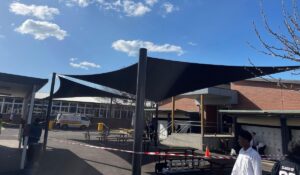

When planning shade for a large site — whether it’s a school playground, sports court, council park, hospitality venue, or commercial property — the question often comes down to this:
Should you choose a standard, off-the-shelf option, or invest in custom commercial shade sails?
At first glance, the difference might seem simple. One is ready-made and quick to install. The other is designed specifically for your site. But for large commercial projects, the decision carries long-term consequences — affecting safety, compliance, durability, and overall value.
This guide explains the real differences, so you can make an informed choice.
What Are Standard (Off-the-Shelf) Shade Sails?
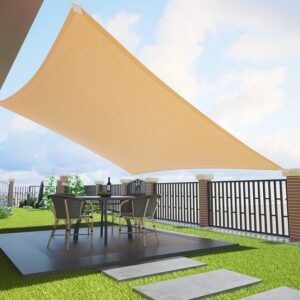
Standard shade sails are pre-manufactured in fixed shapes and sizes — typically triangles, rectangles, or squares. They’re often mass-produced and readily available.
For small residential patios or temporary applications, they can be practical. They’re usually:
- Faster to purchase
- Lower in upfront cost
- Suitable for simple, low-risk installations
However, when scaled up for commercial use, limitations start to appear.
Where Standard Sails May Work
Standard sails can be appropriate when:
- The area is small and uncomplicated
- The installation is temporary
- The structure isn’t permanently fixed
- Wind exposure is minimal
- Budget is the primary concern
For a seasonal café setup or a small courtyard with clear anchor points, this approach may be acceptable.
But large public or commercial environments demand more than convenience.
The Limitations of Standard Sails in Large Projects
Large spaces rarely match fixed sail dimensions. This can lead to:
- Gaps in shade coverage
- Awkward post positioning
- Reduced usable area
- Compromised tensioning
- Limited rain runoff control
In commercial environments, these compromises affect usability, safety, and longevity.
When you’re responsible for schools, sports facilities, or public areas, compromise carries risk.
What Makes Custom Commercial Shade Sails Different?
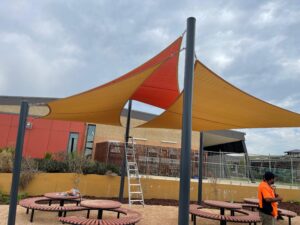
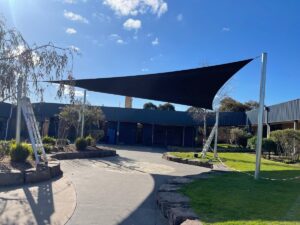
Unlike standard products, custom commercial shade sails are designed specifically for your site. They begin with a proper site assessment and consider:
- Sun direction throughout the day
- Prevailing wind conditions
- Ground and footing requirements
- Clearance heights and pedestrian flow
- How the space is used daily
The result is a solution built around real-world conditions — not assumptions.
For large commercial projects, that precision matters.
A properly planned system often includes structured planning and installation, which you can explore through our shade sail engineering and installation services.
Precision Fit Means Better Coverage
Commercial sites rarely come in perfect shapes. Custom sails allow:
- Exact measurements
- Optimised angles for shade performance
- Proper pitch for rain runoff
- Maximum usable shade area
Instead of adjusting the space to suit the sail, the sail is built to suit the space.
That difference improves both appearance and function.
Structural Planning and Engineering Considerations
Permanent installations over public areas often require proper structural planning. Wind loads vary across Australia, and large spans increase tension forces.
Custom systems allow:
- Site-specific wind considerations
- Appropriate post sizing
- Correct footing depth
- Balanced tension geometry
For large-scale commercial shade structures Australia, engineering isn’t an optional extra — it’s part of responsible design.
UV Protection: A Critical Factor in Australia
In Australia, UV protection is one of the primary reasons shade structures are installed.
High-quality commercial-grade fabric can deliver up to 99% UV protection, depending on the material and design. This level of performance is especially important for:
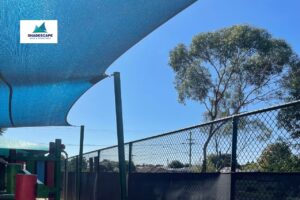
- Schools and childcare centres
- Outdoor classrooms
- Sports courts
- Council parks
- Hospitality seating areas
Not all standard sails use fabric designed for long-term commercial exposure. Lower-grade materials may fade, stretch, or lose tension under harsh UV conditions.
Custom installations allow fabric selection suited to long-term Australian climate performance.
Rain Runoff and Drainage Control
In large spaces, water pooling can damage fabric and fittings.
Standard sails rely on fixed shapes that may not allow proper pitch or fall. Custom systems can be designed with:
- Controlled slope
- Directed runoff
- Reduced fabric strain
This is especially important in sports and hospitality settings where pooled water disrupts use.
Maintenance and Long-Term Performance
Over time, poorly fitted sails often require:
- Frequent re-tensioning
- Hardware replacement
- Fabric repairs
- Structural adjustments
Custom systems, when correctly designed, generally:
- Maintain tension longer
- Resist stretching
- Reduce maintenance frequency
- Deliver better lifecycle value
You can read maintenance tips here:
https://shadescape.net.au/maintenance-tips-for-shade-sails/
Cost: Short-Term Savings vs Long-Term Value
Standard sails often appear cheaper upfront.
However, when factoring in:
- Reduced lifespan
- Potential retrofitting
- Additional posts
- Early fabric replacement
The total cost over time can exceed that of a properly designed custom solution.
For councils, schools, and developers managing budgets long term, lifecycle value usually outweighs initial savings.
When Standard Shade Sails Might Be Enough
To remain balanced, there are cases where standard sails make sense:
- Temporary installations
- Small low-risk spaces
- Seasonal shade requirements
- Simple layouts with minimal exposure
But once a project becomes permanent, public-facing, or structurally significant, expectations change.
Large installations should be treated as infrastructure — not short-term purchases.
Why Large Projects Usually Benefit from Custom Design
For schools, councils, hospitality venues, and commercial developments, custom systems typically offer:
- Precision fit
- Better coverage
- Stronger structural planning
- Reliable UV performance
- Improved rain management
- Reduced long-term maintenance
These advantages reduce risk and increase value.
You can see examples of completed projects here.
Why Choose Shadescape?
At Shadescape, we design and install commercial shade solutions with long-term performance in mind.
Our approach includes:
- Detailed site assessment
- Thoughtful layout planning
- Coordination of engineering where required
- Commercial-grade materials
- Professional installation
- Ongoing support
We understand what’s required for large commercial environments across Australia.
If you’re considering the difference between standard and custom shade solutions, it’s worth speaking to a team that has delivered both — and knows when each is appropriate.
Final Thought
Choosing between standard and custom comes down to risk, scale, and long-term intent.
For small temporary needs, standard options may suffice.
For permanent, high-traffic, or publicly accessible spaces, custom commercial shade sails are typically the smarter investment.
The right choice today prevents problems tomorrow.