
Leaving vehicles exposed in Victoria causes rapid wear; summer UV fades paint and cracks dashboards, while sudden hailstorms dent bonnets and roofs. Winter rain, tree sap and bird droppings make a mess of windscreens. For a shopping centre, a school or an apartment complex, this affects dozens or even hundreds of vehicles at once. For a homeowner, it affects the family car. Either way, the same question comes up: shade sail vs carport, which one is better?
For many years, the usual answer was a steel or polycarbonate roof on a box frame. That is changing, and the change started with commercial properties. Today, modern shopping centres, schools, hospitals and apartment complexes use car park shade sails in Melbourne instead of bulky steel structures. Homeowners have embraced this shift, with driveway shade sails in Melbourne and carport shade sails for their own properties.
This guide starts with commercial car parks, where the evidence is easiest to see, and then moves on to driveways at home. Whether you manage a multi-bay car park in Grovedale near Geelong, run a retail site in Werribee, or want to protect a family SUV in Brighton, we compare both options on weather protection, space, cost, council rules and everyday use. We also tell you honestly when a carport is the better choice.
The Short Answer
For most commercial car parks and for most home driveways, a custom-engineered shade sail is the better choice. It keeps driving lanes and driveways open, cools the area under it, copes well with awkward shapes, and usually costs less to build. A waterproof PVC sail also gives you full rain cover.
A traditional carport can still be the right pick if you want a permanent solid roof, plan to mount solar panels, or need a fully enclosed, secure space. We explain both sides below so you can decide with confidence.
Lessons from Commercial Car Parks: Why Shopping Centres Choose Shade Sails Over Carports
To decide which structure works best over vehicles, look at how commercial property owners allocate their budgets. This clarifies why shopping centres use shade sails instead of carports.
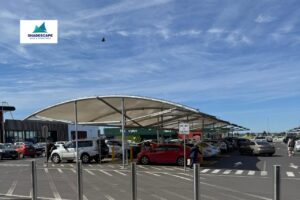
When retail centres, schools, hospitals and business parks need to cover dozens or even hundreds of bays, many choose car park shade sails in Melbourne. Our team has installed several commercial car park shade structures, including a large shopping centre car park, to protect shoppers and their vehicles from harsh Australian weather.
Based on this work, there are three practical reasons commercial owners choose sails over rigid metal carports:
- Open traffic flow. In a busy car park, posts placed between bays often cause scraped bumpers and dented doors. Engineered sails cover wide areas with fewer-placed columns, so driving lanes stay completely clear.
- Cooler surfaces. Large stretches of asphalt absorb the sun’s heat. Breathable shade cloth stops UV rays before they reach the pavement and lets heat escape through the fabric, helping cool down the whole car park.
- A modern look. Instead of a sea of corrugated iron across the frontage, curved sails give the building a clean, architectural look to the building.
What Property Managers Should Check Before Choosing a Structure
If you manage a car park for a shopping centre, a school, an apartment block or a business, these questions will help you compare quotes fairly:
- Post positions. Will the columns sit in garden beds and medians, or between bays? Poor positions lead to scraped bumpers and tight turns.
- Engineering and certification. Is the design certified for local wind loads, and who looks after the building permit?
- Fabric choice. Do you want cooling airflow from HDPE mesh, or full rain cover over bays and walkways from waterproof PVC?
- Maintenance plan. Who will inspect the fabric, hardware, and fixings each year?
- Staged work. Can the contractor build in stages, so part of the car park stays open?
Homeowners can use the same approach. When you install a custom driveway sail at home, you get the same engineering thinking that we use on our commercial projects. The sections below show what that means for your driveway.
Driveway Shade Sail vs. Traditional Carport: Side-by-Side Comparison
When business owners and homeowners ask, “Is a shade sail better than a carport for a driveway or car park?”, they often compare a cheap hardware-store cloth with a permanent steel roof. That is not a fair test. Professionally engineered shade sails come in two main types: breathable high-density HDPE mesh, and 100% waterproof architectural PVC.
The table below compares a waterproof PVC carport sail vs. HDPE mesh, and then both against a traditional hard-roof metal carport.
| Driveway and Car Park Decision Factor | Breathable HDPE Driveway Shade Sail | Waterproof PVC Carport Shade Sail | Traditional Hard-Roof Metal Carport |
| UV and Heat Protection | Very good. Blocks up to 98% of UV rays. The open weave lets hot air rise and escape. | Excellent UV blocking, close to 100%. Solid fabric holds more heat than mesh, so a good design with open sides and airflow matters. | Moderate. It blocks the sun, but steel can heat up and radiate warmth down onto the car, especially in dark colours without insulation. |
| Hail Protection | Good. Taut fabric absorbs and softens the impact, although some hail can pass through mesh. Severe hail can damage any structure. | Good. A tensioned membrane absorbs and deflects hail quietly. Very large hail can still cause damage. | Stops hail from reaching the car, but heavy stones are very loud and can dent steel sheets or crack polycarbonate panels. |
| Rain Protection | Filters light showers. Heavy rain passes through the weave. | 100% waterproof. The solid membrane sheds water towards a low corner. | 100% waterproof, but it needs gutters, downpipes and stormwater plumbing. |
| Driveway Clearance and Turning | Clear-span clearance using wall fixings and perimeter steel posts. | Clear-span clearance, with posts planned away from car doors and turning areas. | Usually needs 4 to 6 vertical posts, often right beside car doors. |
| Fit for Awkward Driveways | Custom 3D-fitted to curved, sloped, triangular, or tight boundary shapes. | Custom 3D-fitted to irregular home or commercial layouts. | Best suited to standard rectangular or square shapes. |
| Upfront Construction Cost | Usually the most cost-effective. No roof trusses, roofing iron, or stormwater trenching. | Good value. You get full rain cover without heavy framing and plumbing. | Usually higher. It needs steel trusses, cladding, guttering, and licensed plumbing. |
| Street Appeal and Council Rules | Light, open look. Still check front setback rules before you build. | Clean, modern look that suits both contemporary and heritage homes. Larger or waterproof structures may need a permit. | Bulky box shape. A carport in front of the building line often needs council approval. |
For Homeowners: 5 Reasons Custom Driveway Shade Sails Outperform Traditional Carports
Now let us look at your home. The same engineering ideas apply to a residential driveway, and there are five main reasons a sail often beats a carport for homeowners.
-
Clear-Span Turning Circles Without Dangerous Support Posts
The biggest complaint homeowners have about a traditional carport is how cramped the driveway feels afterwards. A standard carport has a box frame with vertical steel legs fixed along the edge of the concrete. Every time you reverse out of a tight driveway in Brighton, load children into car seats or open a wide SUV door, those legs are in the way.
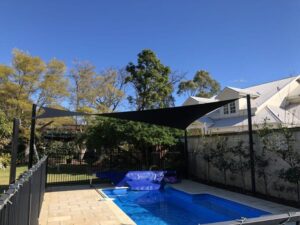
Custom residential shade sails solve this through clear-span vehicle clearance. We combine fixing points on your house or garage with cantilever and perimeter steel posts set in garden beds or along the boundary. This keeps your driveway open. You can reverse a trailer, park a boat, or open every car door fully without worrying about hitting a post.
-
Better Hail Protection Without the Noise of a Metal Roof
Melbourne storms often bring sudden bursts of hail. A steel or polycarbonate carport will keep hailstones off your car, but the roof itself takes a beating. Heavy hail can dent Colorbond sheets, crack brittle polycarbonate panels, and make a deafening noise inside your home.
A properly tensioned sail handles hail differently. Secured tightly with stainless steel turnbuckles and curved edges, so it gives a little when hail lands on it. This hail impact absorption, often called the trampoline effect, softens the blow and bounces ice off the sloped surface. It protects your car’s paint and windscreen without the loud crash of a metal roof.
To be fair, no structure can promise protection from every storm. Very large hail can damage any roof, sail or carport. A well-built sail with quality fabric simply handles typical Victorian hail very well, and it is easier and cheaper to repair than a damaged metal roof.
-
Stopping the “Radiant Oven” Effect on Car Paint and Cabins
On a 38-degree January afternoon in Werribee, standing under a metal carport can feel like standing under a giant heater. Metal roofing absorbs solar heat and can radiate it down onto your car. This heats the cabin and speeds up clear-coat damage.
The difference between radiant heat buildup and breathable thermal ventilation is why HDPE shade sails work so well in summer. Our commercial-grade mesh blocks up to 98% of harmful UV rays, while hot air rises through the tiny gaps in the weave. This steady airflow keeps the space over your driveway noticeably cooler.
-
Custom 3D Shapes for Sloped, Curved or Wedge-Shaped Driveways
Very few Melbourne driveways are flat, perfect rectangles. New estates in growth areas like Werribee and Grovedale, and older homes in bayside Brighton, often have angled boundaries, curved paths or steep slopes leading to the garage.
A rectangular metal carport on a wedge-shaped or curved driveway looks awkward and leaves gaps where the afternoon sun still reaches your car. We measure every sail in 3D, so we can design triangles, trapezoids, or overlapping sails that follow your boundary lines and the slope of your driveway.
-
A Lighter Look That Helps with Council Rules and Front Setbacks
If your driveway sits in front of your house or garage, building a solid-roof carport close to the street is often difficult in Victoria. Councils regulate structures in the front setback because bulky rooflines can block sightlines and dominate the streetscape.
A solid roof also needs guttering and a licensed plumber to connect stormwater to your legal point of discharge. A tensioned sail has a lighter, more open profile, so it often fits more easily into the streetscape. That said, front boundary setback compliance depends on your council, structure dimensions, and the type of fabric. Any structure in the front setback should be checked before you build. Where a permit is needed, we manage the engineering certification and building permit approval for you, as registered commercial builders.
Want 100% Rain Cover? Meet the Waterproof PVC Carport Sail
The main argument for a metal carport is keeping dry while you unload the groceries. Yet, you don’t require a heavy metal roof to keep the driveway dry.
With waterproof shade sails in Melbourne, you get the sleek, open look of a tensioned sail with full rain protection. These sails are made from UV-stabilised architectural vinyl. They block rain, tree sap and bird droppings.
We design each waterproof sail with a high-to-low pitch and a three-dimensional twist, so water runs quickly to a planned drainage point. You get all-weather shelter without the bulk or plumbing bill of a steel carport. Because a solid membrane catches more wind than mesh, these sails need stronger posts and footings, and we engineer them with that in mind.
When a Traditional Carport Is the Better Choice
We build shade sails every day, but a carport is still a valid choice. A traditional carport may suit you better if:
- You want a solid, permanent roof that needs no fabric replacement in the future.
- You plan to install solar panels on the roof.
- You want a fully enclosed space with walls or doors for security or storage.
- Your site is in a very exposed, high-wind location where a solid frame is the simpler engineering solution.
If none of these apply, a sail will usually give you more clearance, more flexibility and better value. If you are unsure, we are happy to talk through both options on site.
How Much Does a Driveway Shade Sail or Carport Cost in Melbourne?
Every driveway is different, so we do not quote a single price without measuring first. These are the factors that affect the cost of either option:
- Size and shape. A larger or more complex layout needs more fabric, posts, and engineering.
- Fabric type. HDPE mesh is usually more affordable than waterproof PVC.
- Posts and footings. Wind loads, soil type, and the number of posts change the structural work.
- Drainage and plumbing. A carport needs gutters and stormwater connections. A mesh sail does not.
- Permits and engineering. Larger or front-setback structures may need a building permit and certification.
A traditional carport usually costs more because of the trusses, roof sheets and plumbing. A sail puts more of your budget into steel posts, quality hardware and high-performance fabric. Contact us for a free measure and a clear, written quote.
Commercial-Grade Engineering: Anchoring to Brick Walls, Slabs and Footings
A driveway shade sail is only as reliable as the engineering behind it. Wind over an open driveway can create a very large pull on each fixing point. This is why many DIY kits fail in winter gusts.
We design our sails to comply with Australian standards, including AS/NZS 1170.2 for wind loads and AS/NZS 4174 for shade fabric. Here is how we approach the key details:
- Safe wall connections. We never bolt a sail directly to a timber roof fascia. As we explain in our guide on why attaching a shade sail to your roof fascia is a costly mistake, wind uplift can pull fascia boards away from the rafters. We use internal rafter brackets and engineered connections instead.
- Masonry and concrete anchoring. When we connect to garage brickwork or an existing slab, we check the base carefully beforehand. Our guide to brick wall and concrete slab structural anchoring explains how chemical anchors, load-spreading plates and deep reinforced footings keep the structure stable.
- Local wind and coastal conditions. From salty bayside gusts in Brighton to open-plain winds in Werribee and shade sails in Geelong suburbs like Grovedale, we choose 316 marine-grade stainless steel hardware and deep-set posts to suit your soil and wind conditions.
How Long Do Shade Sails Last, and How Do You Look After Them?
A quality shade sail can last for many years, but lifespan depends on fabric quality, hardware durability, and ongoing maintenance. An annual inspection is a simple way to avoid bigger repairs. Look for loose fixings, small tears, sagging fabric, and rust on hardware.
If your current sail looks tired, our maintenance and repair service plus our shade sail audit and inspection can determine whether it needs servicing, re-tensioning, or a full replacement.
FAQs
Can a shade sail cover a commercial car park or shopping centre?
Yes. Many commercial car parks use engineered shade sails because they cover large areas, keep driving lanes clear, and reduce surface heat. We have installed several commercial car park structures; we ensure every project is custom-designed, certified, and built specifically for the site.
Do driveway shade sails actually protect cars from Melbourne hailstorms?
In most cases, yes. A tensioned HDPE or PVC sail absorbs the impact of falling hail and reduces the force that reaches your car. It does not dent or shatter like a metal or polycarbonate roof. However, no structure is completely hail-proof, and very large hail can damage any cover. Quality fabric, correct tension, and strong engineering make a big difference.
Can a driveway shade sail be completely waterproof like a metal carport?
Yes. Standard knitted mesh is breathable and lets heavy rain pass through. A tensioned architectural PVC membrane is 100% waterproof. It is built with a slope so water runs off to a drainage point, which keeps your car and driveway dry through winter.
Do I need a council building permit for a driveway shade sail in Melbourne?
It depends on the size, height, fabric specifications, and where the sail sits in relation to your front setback. Some small, permeable shade structures behind the front building line may not need a permit. Larger spans, front-setback installations, and waterproof membranes often do. Rules can also differ between councils, so check before you build. Our registered building team can handle the council process and engineering certification for you.
Will attaching a driveway shade sail damage my garage brick wall or roof fascia?
A DIY job bolted to brick veneer or a timber fascia can cause serious damage in strong winds. A professionally engineered installation is different. We use load-spreading steel brackets connected to roof trusses, structural beams or deep concrete footings, so the load is carried safely without stressing your brickwork or roofline.
Why are shade sails more cost-effective than building a traditional carport?
A traditional carport needs steel framing, roof sheets, flashing, gutters and a licensed plumber to connect downpipes to your stormwater system. A custom shade sail avoids most of that; instead, funds go toward strong steel posts, marine-grade hardware, and high-performance fabric.
How long does a driveway shade sail last?
With quality fabric, good hardware and regular checks, a professionally installed sail can last many years. Cheap, untested fabric and poor fixings are the most common reasons sails fail early.
Ready to Protect Your Car Park or Driveway?
Don’t wait for another scorching summer to fade your paint, or for the next hailstorm to dent your bonnet. Whether you need a heavy-duty waterproof structure for a multi-bay commercial car park or a breathable canopy for a sloped suburban driveway, ShadeScape Sails & Structures delivers custom-engineered solutions built for Victorian conditions.
Contact our Melbourne team today to book your free on-site measure, 3D design consultation, and no-obligation quote.