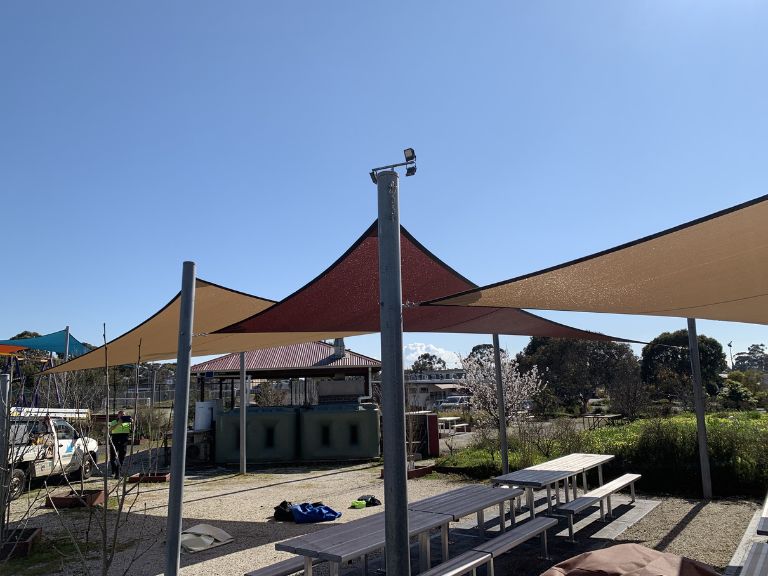
To design a custom shade sail, track where the sun falls across the seasons, choose a matching shape and fabric, measure from the centre of each fixing point, and make sure the posts, footings and hardware are engineered for wind. Check permit rules before you build, because size, height and fabric type all matter in Victoria. This guide walks you through each step, with practical DIY shade sail design tips and the questions to ask your fabricator.
Melbourne can serve up a harsh UV afternoon and a cold, soaking downpour in the same week. That’s why off-the-shelf kits often disappoint, and why custom shade sails built for your site make sense. These are the Melbourne weather shade solutions worth planning for.
Step 1: Map the sun before you sketch
- Track the seasons: The summer sun sits high, and the winter sun sits low. A sail that gives perfect midday shade in January can miss the mark by autumn.
- Think about the angle: Shade is most effective when the sail is directly overhead, so low morning or afternoon sun may need a second sail or side protection.
- Define the job: A play area, pool, outdoor dining spot, and car park each require different sizes, heights, and fabrics.
Step 2: Choose a shape (triangle vs rectangle shade sails)
| Shape | Best for | Keep in mind |
| Triangle | Patios, small spaces, tight corners | Fewer fixing points, modern look |
| Rectangle or square |
Courtyards, driveways, car parks | Even coverage, needs four solid anchor points |
| Hypar (twisted) | Larger spans, architectural looks | Opposite corners set high and low to keep the fabric tensioned |
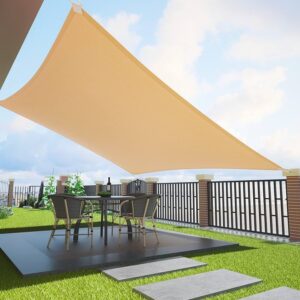
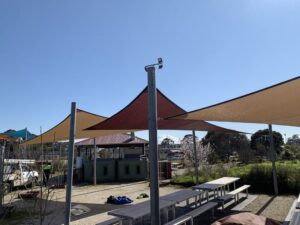
Often your available fixing points decide the shape before style does. Multiple overlapping sails can also cover an irregular area better than one large one.
Step 3: Choose the fabric (best materials for custom shade sails)
| HDPE shade cloth | Waterproof PVC | |
| Rain | Some water filters through | Water doesn’t pass through the fabric |
| Airflow | Breathable, hot air escapes | Not breathable |
| Wind load | Air passes through | Catches more wind, so engineering matters more |
| Pitch | Standard fall | Needs enough pitch for runoff |
| Permit | Often exempt within limits | Generally treated differently (see Step 7) |
Whichever you choose, look for a UV rating tested to AS 4174:2018. A higher UVE rating means better protection, but no fabric is 100%, and shade works alongside a hat and sunscreen rather than replacing them. A waterproof sail with curved sides and no walls can still get a little wet underneath in wind-driven rain.
Step 4: How to measure for a shade sail
- Measure from the centre of each fixing point (the hardware eye or a mark on the post), not from where the post meets the ground.
- Sketch the layout and label the corners A, B, C, D, working clockwise.
- Measure each side and the diagonals. The diagonals confirm your shape is square.
- Record every height from the same ground reference, because a sail needs fall for water runoff.
- Use millimetres, and use rope for long runs if your tape is too short.
Your fabricator will make the sail slightly smaller than the anchor-to-anchor distance, which leaves room for hardware and tension.
Step 5: How to tension a shade sail
A saggy sail is usually an engineering problem, not a fabric problem.
- Catenary curves: Edges that curve gently inward spread tension from the corners across the whole sail.
- Quality hardware: Marine-grade stainless steel shackles, turnbuckles, and corner plates hold the tension.
- Tension until firm, then stop: The sail should be rigid with no creases; over-tensioning places extra load on the fabric and fixings.
Step 6: Check your structure and footings
A sail is only as strong as what it’s fixed to.
- Existing structures: Brick walls, fascias or solid timber can work if they’re engineered for wind loads. See our guide to attaching a shade sail to a brick wall or concrete slab.
- Posts and footings: Without a suitable anchor, you’ll need engineered steel posts in concrete footings sized for your site and sail.
- Local conditions: Exposed sites, large spans and waterproof fabrics all increase the loads.
Step 7: Permits in Victoria
Many Victorian councils say a standard, permeable shade sail doesn’t need a building permit if it’s no larger than 20 m², no higher than 3.6 m and meets siting rules. Many sails exceed one of those limits. Waterproof (non-perforated) sails are generally treated differently and usually need a permit. Rules vary by council and site, so confirm with your council or a registered building practitioner before you build.
Step 8: Questions to ask your fabricator
- Can you provide a 2D layout and a 3D diagram of the design?
- Is the fabric tested to AS 4174:2018, and what is its UVE rating?
- What pitch does the sail need to shed water?
- Who handles the building permit, if one is needed?
- Are posts and footings engineered for my site?
Frequently asked questions
How do I design my own shade sail?
Start with the sun path and your purpose, choose a shape and fabric, measure from fixing point to fixing point, then have the posts, footings and hardware checked for wind loads. A registered builder can finalise and install the design.
Triangle or rectangle shade sails: which is better?
Neither is better overall. Triangles suit smaller areas and tight corners, while rectangles suit wide areas like courtyards and car parks. Your available anchor points usually decide.
Should I choose HDPE or waterproof PVC?
Choose HDPE for breathable sun protection. Choose PVC if you want rain cover, and plan for pitch, stronger engineering and a likely building permit.
Do I need a building permit for a shade sail in Victoria?
It depends on size, height, siting and fabric type. Many councils exempt standard sails up to 20 m² and 3.6 m high, but waterproof sails generally need a permit. Check with your council or a registered building practitioner.
Can I install a custom shade sail myself?
Small kits suit basic residential jobs, but custom and large sails carry significant wind loads on the posts and fixings, and may need a permit. We recommend a registered builder.
Ready to design yours?
If you’d like a hand, ShadeScape Sails & Structures offers a free measure, professional consultation and a custom quote for shade structures in Melbourne and shade sail installation in Victoria, including Geelong. Start with our custom shade sails Melbourne page or get in touch.