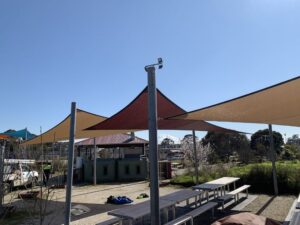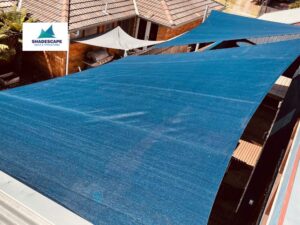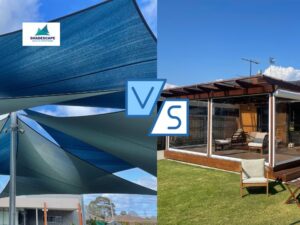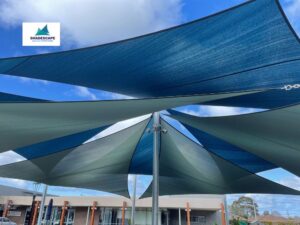
Investing in a large commercial outdoor shade canopy—whether for a school basketball court, a childcare center, a public park, or a commercial venue—is a major decision. You need a structure that protects people from intense UV rays and heavy rain, but above all, it must be safe, stable, and built to withstand severe weather conditions for decades.
Cheap, thin posts and flat shade sails frequently buckle, rust from the inside out, and fail under extreme weather conditions. The true strength, safety, and lifespan of any high-performance canopy depend on two critical choices: the roof design and the structural steel posts supporting it.
-
Roof Architecture: Curved vs. Flat Designs
An arched design isn’t just about modern aesthetics—it is a proven engineering solution for harsh weather and wide-span spaces. When planning a commercial outdoor shade canopy, the structural shape plays a key role in how well the installation survives heavy rain, high winds, and intense UV exposure.
- Aerodynamic Wind Shedding: Arched barrel vault shade structures dissipate wind lift far better than flat designs. Gale-force winds flow smoothly over the curved roof surface, allowing air to pass across the structure instead of creating the high pressure that can build up underneath a flat plane.
- Instant Water Runoff: Rainwater flows down the arch, eliminating the risk of water pooling and fabric stretching.
- Superior Overhead Clearance: The high central peak easily accommodates high-clearance sports such as basketball, netball, and volleyball without adding excessive wall height.
- Even Fabric Tensioning: Curved structural rafters keep the canopy membrane consistently tight, preventing destructive fabric “flapping” during storms.
Comparing Roof Styles
When evaluating options, Arched Barrel Vault Canopies offer exceptional wind performance, zero pooling risks, and clear-span capabilities over 30+ meters without center posts—making them ideal for basketball courts, school Covered Outdoor Learning Areas (COLAs), and assembly zones.
By contrast, Flat Hip & Ridge Structures offer moderate wind performance and are best suited to smaller spaces, like sandpits or dining patios, while Cantilever Steel Structures provide medium spans when support posts can only be placed on one side, such as in car parks or spectator grandstands.
-
Steel Column Engineering: Why 250 NB CHS Steel Posts Win
When reviewing engineering specifications for a heavy-duty shade canopy, you will often see technical codes describing the structural support columns. The industry gold standard for large spans is 250 NB CHS steel pipe.
- 250 NB (Nominal Bore): Standard industry sizing reference.
- 1 mm Outside Diameter: The actual width of the round steel pipe (~27.3 cm across).
- CHS (Circular Hollow Section): A smooth, round steel profile shape.
- 0 mm Wall Thickness: Structural C350/C250 grade steel wall thickness.
- Heavy Weight: Weighs approximately 33.1 kg per meter, offering heavy structural ballast against wind uplift.
Why Round CHS Pipes Outperform Square SHS Posts
Round CHS columns offer 360-degree equal strength. While square posts (SHS) are strong across their flat sides, they can be weaker on their corners. Round CHS columns provide uniform bending strength in every direction, making them highly effective against unpredictable wind shear.
Round posts also prioritize safety. Schoolyards, childcare centers, and sports grounds are active play zones. Round columns eliminate sharp 90-degree steel edges, dramatically reducing the severity of accidental player impacts. Furthermore, their low wind drag allows air to move smoothly around the cylinder, while the rounded tops naturally shed dirt, leaves, and water, helping reduce the risk of localised corrosion.
-
The 4 Non-Negotiable Structural Upgrades
To ensure a commercial canopy stands for 15 to 25+ years without structural failure, four core engineering upgrades must be included:
- Hot-Dip Galvanizing (HDG): Spraying or powder coating untreated raw steel leaves the inside of the pipe unprotected against ambient air moisture, causing it to rust from the inside out. With Hot-Dip Galvanizing (HDG), the entire fabricated steel post is submerged into a molten zinc bath at over 440°C. This coats both the inside and outside surfaces, creating a permanent metallurgical bond that prevents rust for decades.
- Sealed Steel Top Caps: Open-topped steel pipes collect rainwater, condensation, and dirt, leading to unseen internal rust at ground level. Heavy-duty steel top caps are continuously seam-welded onto the top of every column before galvanizing, permanently sealing the internal cavity.
- Angled Post Rake & Lean Dynamics: High-tension canopy fabric exerts a substantial inward pull on the tops of the support posts. Installers set outer steel columns at a calculated outward angle (known as rake/lean). When the membrane is pulled to full tension, the leaning and pulling forces balance, leaving the post perfectly straight under a balanced load.
- Deep Concrete Foundations: A 6-meter-tall shade post acts as a giant lever in severe winds. Standard shallow footings will loosen or pull clean out of the ground. Heavy-duty structures require deep concrete foundations(piers drilled 8m to 2.5m deep) packed with engineered steel rebar cages tied directly into the column’s baseplate.
- Choosing Your Canopy Fabric
Selecting the right upper membrane is just as important as the frame underneath. If you are comparing traditional options for lighter residential or commercial properties, explore Residential Shade Sails to understand fabric variations. For large commercial-scale builds, your two primary fabric choices are:
- Waterproof PVC Membrane: Delivers 100% rain protection and 100% UV blocking. It is ideal for year-round outdoor classrooms, spectator seating, and covered walkways. For project that requires reliable, all-weather shade over parking areas or vehicle drop-off zones, explore dedicated Car Park Shade Sails.
- Commercial Knitted Shade Cloth (HDPE): Delivers up to 98% UV protection while remaining water-resistant and highly breathable. It allows hot air to rise through the mesh, making it an effective choice for summer heat reduction over playgrounds and active sports courts.
FAQs
What is the difference between Hot-Dip Galvanizing (HDG) and standard spray painting?
Standard spray paint or powder coating only creates a thin protective shell on the outside of the pipe. Hot-Dip Galvanizing (HDG) completely submerges the steel post in molten zinc, coating both the inside and outside of the pipe to permanently prevent internal rust.
Why are 250 NB CHS posts safer for school playgrounds and basketball courts?
Round 250 NB CHS steel pipe columns have smooth, rounded edges with no 90-degree sharp corners. This significantly lowers the risk of impact injury during play. Educational facility managers can learn more about regulatory standards and custom coverage in our specialized guide for School Shade Sails.
What causes flat shade canopies to sag and flap in strong winds?
Flat shade canopies can catch strong wind from underneath, creating significant uplift. Without a curved profile to help direct the wind over the structure, the fabric can gradually lose tension and develop low spots where rainwater collects, leading to further sagging over time.
How deep do support post concrete footings need to be for a commercial canopy?
Because tall columns act as long levers in severe winds, heavy-duty structures often require deep concrete foundations, typically drilled 1.8 to 2.5 meters deep and reinforced with heavy steel rebar cages.
Do commercial outdoor shade canopies require local council building permits?
Yes. Any large commercial shade canopy, school COLA, or high-span structure in Victoria may require formal structural engineering calculations and wind load assessments (AS/NZS 1170.2 standard) before council approval can be issued.
Planning a Commercial Canopy Project?
Whether you need to cover a school court, childcare playground, or commercial venue across Melbourne, Geelong, or Greater Victoria, ShadeScape provides complete end-to-end service: initial design, structural steel engineering, fabrication, and certified site installation.
To learn more about our full commercial capability, visit our Commercial Shade Sails hub or reach out to our team directly.