
A waterproof sail turns an open space into an all-weather space. But it only works well if the water has somewhere to go. If you want to prevent water pooling on shade sails, the single most important factor is the slope, also called the fall or pitch.
A breathable shade cloth lets air and light rain pass through its weave. An architectural PVC membrane blocks all water. That water needs a clear path off the canopy. Without a proper fall, rain collects in the middle of the fabric. The weight stretches the seams, bends the posts and can pull fixings out of walls.
This guide explains how much slope a waterproof sail needs, how to set it up, and how to fix a sail that already holds water. It applies to a school courtyard in Grovedale, a commercial walkway in Brighton or a home patio in Werribee.
Key Takeaway
A common starting point for a waterproof sail is a fall of about 20%, or 1:5. That means a drop of 200 mm for every metre of horizontal run, which is roughly 11 degrees. In areas with sudden heavy rain, many designers steepen this to about 25%, or 1:4. Your engineer may specify more, depending on the size, fabric and site.
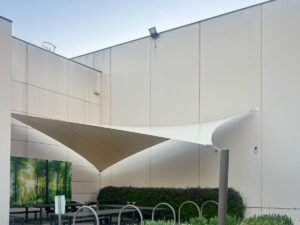
On a four-corner sail, the best way to get this fall is a three-dimensional hypar twist. Two diagonal corners sit high and the other two sit low. The saddle shape keeps the fabric tight and sends water to the low corners.
Why Flat Waterproof Sails Fail: The Physics of Water Pooling
Water is heavier than most people expect. One litre of water weighs about one kilogram.
A short, heavy burst of 10 mm of rain over a 6 m by 5 m sail adds up to about 300 litres. If the sail is almost flat, that water cannot run off. It gathers at the lowest point in the middle of the span.
As the pool of water grows, it pushes the fabric down and forms a sagging water belly. The deeper the belly, the more water it traps. In a long storm, a flat sail can hold hundreds of kilograms of water.
That extra load can cause serious problems:
- Permanent stretching. The membrane can stay saggy even after it dries.
- Bent posts. The weight pulls the tops of the posts inwards and puts strain on the footings.
- Stressed seams. Pooled water can find weak seams or stitch holes, which can cause dripping or fine misting underneath.
- Failed fixings. In severe cases, brackets or anchors can pull away from brick walls or timber fascia boards.
This is why a professionally designed waterproof sail is never flat. If you are comparing options, our waterproof shade sails in Melbourne are designed with the fall built into the geometry from the start. You can see how we approach them on our waterproof shade sails page.
How Much Slope Does a Waterproof Shade Sail Need?
There is no single number that suits every site, and recommendations from suppliers can vary. Some use about 20% (1:5) as a minimum. Others suggest 10 to 15 degrees, and some recommend 30% or more. These figures are not as different as they might appear, because percentages and degrees represent entirely different units of measurement.
Here is how they convert:
| Fall Ratio | Slope Percentage | Approximate Angle |
| 1:6 | about 17% | about 9.5 degrees |
| 1:5 | 20% | about 11 degrees |
| 1:4 | 25% | about 14 degrees |
| 1:3 | about 33% | about 18 degrees |
For most waterproof sails, we use 1:5 as the lowest baseline and aim higher where the site allows. A steeper fall drains faster, keeps the fabric tighter and gives a better look. We confirm the final waterproof shade sail slope with engineering for each project.
The table below shows how much height difference you need across common spans.
| Horizontal Span | Baseline Fall (1:5, 20%) | Recommended Fall (1:4, 25%) | What to Expect in Heavy Rain |
| 3.0 m | 600 mm drop | 750 mm drop | Quick runoff. Suits small courtyards and walkways. |
| 4.0 m | 800 mm drop | 1,000 mm drop | Reliable drainage for most small patios. |
| 5.0 m | 1,000 mm drop | 1,250 mm drop | A good standard for residential patios and double carports. |
| 6.0 m or more | 1,200 mm drop | 1,500 mm drop | Usually needs engineered 3D hypar shaping. |
These are general guides rather than strict rules for every site. Fabric type, tension, wind exposure, and the overall geometry of the sail all influence how effectively water drains off.
Choosing the Designated Drainage Corner
Good slope also means deciding where the water will end up. Plan the lowest corner before you build.
When you choose the designated drainage corner, keep these points in mind:
- Away from walls and footings. Do not direct the low corner at a house wall, footpath or neighbour’s fence.
- Toward a safe exit. A garden bed, lawn, gravel trench or stormwater drain is a better outlet.
- Clear of walkways. Runoff should never spill across pedestrian pathways, especially in a school or a commercial site.
- Checked against drainage rules. Check where stormwater is allowed to go on your property before you finalise the design.
Single Slope vs. Hypar Twist: Why Geometry Matters
A triangular sail can shed water cleanly with one corner set lower than the others. A four-corner sail is trickier.
If you tilt a four-corner sail like a lean-to roof, the fabric forms a flat plane. A flat plane has no curve to hold tension evenly, so it can sag in the middle, flutter in the wind and hold small pockets of water.
A hypar twist, short for hyperbolic paraboloid, solves this. Two opposite corners are set high, and the other two are set low. The surface curves in two directions at once, which makes the fabric stiffer and more stable.
This geometry gives you three benefits:
- Balanced tension. The high diagonal pulls up and the low diagonal pulls down. These forces lock the fabric in place and reduce flapping.
- Two drainage paths. Water runs towards the two low corners instead of one flat slope.
- A tighter, cleaner look. Curved edges, called catenary curves, and strong stainless steel hardware keep the membrane tight across the whole surface.
A hypar needs enough height difference to work. If the corners are too close in height, the twist is weak, and the sail may still hold water.
Fabric Quality Also Matters
Slope is the main factor; membrane quality also plays a crucial role.
A good architectural PVC membrane is non-porous and has welded seams made with high-frequency welding. Welded seams are stronger and more watertight than basic stitching. Many commercial-grade membranes also have a protective topcoat, such as a PVDF lacquer, which helps the surface stay cleaner and last longer in strong UV.
Cheap, thin vinyl tarps are a different product. They stretch easily, have weak seams and are not built to hold tension for years. A premium fabric will not fix a poor slope, but a poor fabric makes every other problem worse.
When a Breathable Mesh Sail Is the Better Choice
Waterproof sails are excellent for the right site, but they are not always the best fit. A breathable HDPE mesh sail is often the smarter option when:
- The mounting heights are low. If your roofline or fence does not provide adequate height difference, you may not reach a safe fall. Mesh lets water pass through, so pooling is not an issue.
- Airflow and heat are priorities. Solid PVC works like a roof and can hold warm air underneath on hot, still days. Mesh lets heat escape and blocks up to 98% of UV.
- The site is very exposed. A solid membrane carries much higher wind loads than mesh. On exposed bayside sites or open plains, a waterproof sail needs larger footings and heavier posts. Read our guide to shade sails in high wind areas if your site is open.
If you are not sure which one you need, our comparison of waterproof shade sails vs mesh in Melbourne winters will help you decide.
Engineering and Compliance in Victoria
A tensioned waterproof sail acts like a solid canopy in rain and wind, so the structure needs proper engineering. These standards matter:
- AS/NZS 1170.2. This is the Australian Standard for wind actions. It guides the calculations for posts, brackets and footings.
- Manufacturer specifications for the membrane. AS/NZS 4174 covers knitted and woven shade fabrics, so it applies to mesh sails. For PVC membranes, we follow the manufacturer’s specifications and design the structure to the wind standard.
Fixing points need as much care as the fabric. Fascia boards are made to carry light guttering, not the wind uplift and water weight of a tensioned sail, so we avoid fixing waterproof sails to them. Instead, we use engineered steel rafter brackets, reinforced concrete pads or freestanding steel posts set in deep footings. If you plan to fix to masonry, read our guide on how to attach a shade sail to a brick wall or concrete slab.
Permits depend on your project. Solid waterproof canopies are more likely to need a building permit than small mesh sails, because they behave like roofs under rain and wind. The rules depend on the size, height, structure and location, so confirm with a registered building surveyor. We handle engineering and permit support as registered commercial builders.
Signs Your Sail Is Holding Water
Check your sail after the next heavy rain. These signs suggest a slope problem:
- A visible dip or belly in the middle of the fabric
- Water that stays on the sail long after the rain stops
- Leaning posts, or posts that look bent near the ground
- Dripping or a fine mist from seams
- Creases or a baggy look that does not tighten up when dry
- Brackets or fixings that look loose or cracked
How to Fix Water Pooling on an Existing Shade Sail
If your waterproof sail already sags or holds water, act before the fabric tears or hardware fails:
- Re-tension the corners. Over time, wind and heat cycles loosen turnbuckles and wire ropes. Re-tensioning can remove small sags.
- Change the anchor heights. If the corners are almost level, lowering one or two corners can restore the fall. This may mean a longer post or a dropped wall bracket.
- Check for permanent stretch. If water has sat on the sail for days, the membrane may be stretched beyond recovery. In that case, re-tensioning will not remove the pocket, and the fabric may need to be re-cut or replaced.
- Book an inspection. A shade sail audit and inspection checks the posts, footings, fixings and tension before the next storm season.
Only a professional should climb or adjust a large sail. Tension and height work carries real safety risks.
What Affects the Cost of a Waterproof Shade Sail?
A waterproof sail usually costs more than a mesh sail, mainly because it needs stronger engineering. These factors affect the price:
- Size and shape.Larger spans and 3D hypar designs need more design work.
- Fabric and seams.Higher-grade membranes and welded seams cost more.
- Posts and footings.Solid fabric carries more wind load, so posts and footings are larger.
- Drainage details.The low corner and runoff path may need extra work.
- Permits and certification.Larger or solid structures may need a building permit and engineering.
Contact our team for a free site measure and a clear written quote.
FAQs
How much slope does a waterproof shade sail need?
A common starting point is a fall of about 20%, or 1:5. That is a drop of about 1 metre for every 5 metres of horizontal run, or roughly 11 degrees. Many designers use about 25% (1:4) where heavy rain is likely. The exact specifications for your site should be confirmed by your engineer.
Why does my shade sail sag in the middle?
Sagging usually means the sail was not tensioned enough, was set too flat or has stretched over time. Water then collects in the dip and makes it worse. Re-tensioning or changing the corner heights can help, but a stretched membrane may need replacing.
Can a shade sail hold water?
A waterproof sail can hold water if it is flat or loose. It is not built to withstand pooled or standing water. A well-designed sail has sufficient fall to ensure rainwater runs off quickly.
Why is my waterproof shade sail dripping or misting underneath?
Pooled water is a common cause. Standing water can find weak seams or stitch holes and drip through as a fine mist. Other causes include damaged fabric, poor seams or loose fixings. A professional inspection can tell you which one it is.
Can you fix water pooling without replacing the whole sail?
In many cases, yes. If the fabric has not stretched for good, adjusting the corner heights or re-tensioning the corners can fix the problem. Our shade sail maintenance and repairs team handles this work.
Will water pooling damage my posts and walls?
It can. A sail holding hundreds of kilograms of water can bend posts, strain footings and stress brackets. In serious cases, it can pull fixings out of walls or fascia boards.
Are triangular sails easier to slope than rectangular sails?
Often, yes. A triangle is simple to pitch because dropping one corner creates a clear runoff path. But triangles give less shade than four-corner sails. That is why many patios and car parks use rectangular sails with a hypar twist.
How do I stop runoff from flooding my patio or garden beds?
Plan the drainage before you build. Slope the lowest corner toward a soakwell, gravel trench, garden bed or stormwater drain, and keep it well clear of walls, footpaths and neighbours.
Do I need a permit for a waterproof shade sail in Victoria?
It depends on the size, height, fabric and location. Solid waterproof canopies are more likely to need a building permit than small mesh sails. Ask a registered building surveyor or your council before you build.
Protect Your Space with an Engineered, All-Weather Sail
Reliable rain protection needs more than stretching a sheet between posts. It needs the right geometry, strong tensioning hardware and certified structural steel—all designed for Victorian weather.
Whether you need a heavy-duty commercial canopy or a patio upgrade at home, ShadeScape Sails & Structures brings over 10 years of experience to every project. Book a free site measure and quote with our Melbourne team today.