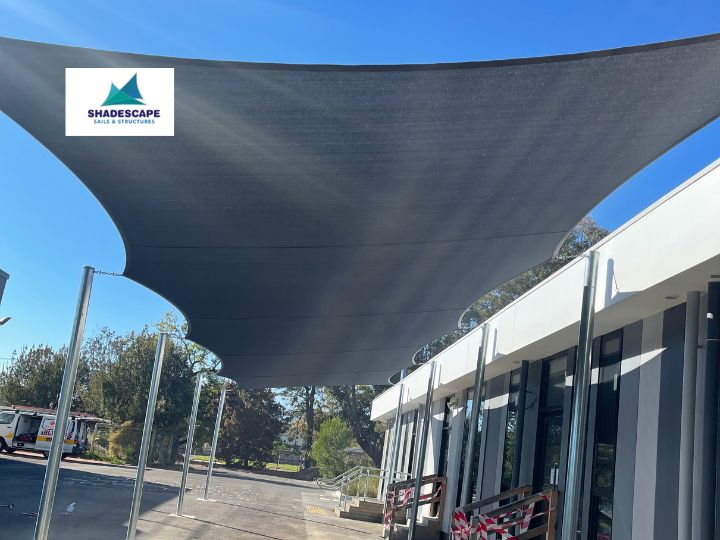
Ask two different shade sail suppliers about fabric weight, and you’ll often get two different answers — one will tell you heavier is always better, the other will tell you it depends on the job. The honest answer is closer to the second one.
Shade sail fabric weight, measured in grams per square metre (GSM), is one of the clearest predictors of how a sail will perform — but it isn’t a simple case of “more is better” across the board. Heavier fabric genuinely does improve UV block, tear strength, and wind stability up to a point. Past that point, it starts working against you: more load on your posts and footings, less airflow underneath, and a higher price for performance you may not actually need.
This guide breaks down what GSM actually means, how it affects UV protection, wind performance, water handling, and lifespan, and — just as importantly — where a heavier fabric stops being an advantage and starts being overkill.
What Does GSM Actually Mean?
GSM stands for grams per square metre; it’s the standard way fabric weight is measured across shade cloth, HDPE, and PVC-coated sail material. In Australia, the way this is measured and reported is governed by AS 4174:2018, the standard covering knitted and woven shade fabrics, which sets out how mass per unit area, UV transmission, and strength are tested and labelled.
In practical terms, a higher GSM number means a denser weave and a heavier fabric. That density is what drives most of the performance differences discussed below.
As a rough industry guide:
| GSM range | Typical description | Best suited to |
| Under 160 GSM | Lightweight, more open weave | Short-term or seasonal residential shade, budget applications |
| 160–230 GSM | Mid-weight, the most common residential range | Backyard patios, pergolas, small courtyards |
| 230–320 GSM | Heavy-duty, tighter weave | Semi-permanent and light commercial use, schools, cafés |
| 320-GSM and above | Extra heavy-duty, densest weave, or PVC-coated | High-traffic commercial sites, large spans, coastal or high-wind locations |
These bands aren’t a strict rulebook — the right choice always depends on the specific site, span, and exposure — but they’re a useful starting point for understanding why two sails that look identical can perform very differently.
UV Protection: Where Weight Matters Most
Blocking harmful UV radiation is typically the main reason a shade sail gets installed in the first place, and it’s where fabric weight makes the most consistent difference.
Fabrics above roughly 230 GSM are almost always woven more tightly than those under 160 GSM, so there’s less room for UV radiation to pass through. As GSM increases, UV block typically rises accordingly: fabrics under 160 GSM commonly sit in the 90–94% UV block range, while fabrics from around 200 GSM upward regularly reach 95–99% block, depending on the weave and colour.
UV treatment during manufacturing (UV-stabilising additives woven into the fibre) also plays a role independent of weight, which is why two fabrics of the same GSM can still have slightly different UV performance. Weight and treatment work together, not as substitutes for one another.
Wind Resistance: More Nuanced Than “Heavier Is Stronger”
This is the category where the “heavier is always better” advice starts to break down.
It’s true that fabric in the 230–320 GSM range and above resists fluttering and flapping better than fabric under 160 GSM — lighter material catches more wind, and that movement puts repeated stress on stitching, D-rings, and fixing points over time. In that sense, a properly specified 230+ GSM fabric genuinely holds its shape better in a blow.
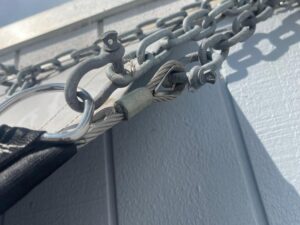
But here’s what often gets left out of this conversation: a sail at 320+ GSM also catches more wind load overall, and that load has to go somewhere. Every extra kilogram of fabric tension goes straight into your posts, footings, and fixing hardware. A 320+ GSM sail across a large commercial span needs a structural system engineered for that load: bigger posts, deeper footings, stronger fixings, not just “a sturdier fabric.” Installing a 320+ GSM fabric on a structure specified for something lighter doesn’t solve a wind problem; it can just move the failure point from the fabric to the frame.
This is why wind exposure should be assessed as part of the whole system, not just treated as a fabric-only decision. For a closer look at how site exposure and wind loading affect the structure under the sail, check out ShadeScape’s guide to shade sails in high-wind areas, and for larger spans, structural engineering is worth considering well before fabric selection.
Water Drainage and Water Resistance
Denser fabrics from around 230 GSM upward tend to be more water-resistant than fabric under 160 GSM, simply because the tighter weave lets water bead and run off rather than soaking through. That said, most standard HDPE shade fabrics, regardless of weight, are designed to be water-resistant rather than fully waterproof; they’ll shed light rain but aren’t built to hold back sustained downpours.
Fabric weight affects water drainage performance too, just in a more indirect way: fabric from 230 GSM upward holds its shape and tension better over time, which helps maintain the pitch (slope) a sail needs to shed water properly. Fabric under 160 GSM that sags loses its pitch, and pooling water on any shade sail — regardless of GSM — is what causes premature sagging and tearing.
If year-round rain protection is the actual goal rather than sun protection with light rain tolerance, that’s a different fabric category (PVC-coated or laminated) rather than simply moving up the HDPE weight range. ShadeScape’s dedicated guide on waterproof shade sails covers that distinction in more detail.
Durability and Tear Strength
Fabric from around 230 GSM upward generally delivers higher tear strength than fabric under 160 GSM, thanks to both the density of the weave and the quality of the individual fibres used. Under AS 4174:2018, shade fabric is tested for strength both before and after a defined period of UV exposure, which is a useful benchmark when comparing suppliers — a fabric that only lists its “new” strength figures isn’t telling you the full story of how it will perform after a few Australian summers.
In general, fabric at 320 GSM and above costs more upfront but tends to need less frequent replacement, which can make it the better long-term investment for a commercial or high-traffic installation. For a lightly used residential courtyard, that trade-off looks different — the additional cost of a top-tier 320+ GSM fabric may outweigh the marginal durability benefit for a space that sees a fraction of the wear.
If you’re weighing that decision for your own property, ShadeScape’s comparison of commercial vs residential shade sails explains how usage level should influence your choice of fabric grade, rather than relying on weight alone.
Aesthetic Appeal: Drape and Shape
Weight also affects how a sail looks once it’s tensioned. Fabric from around 230 GSM upward typically holds a deeper, cleaner drape with more defined lines, while fabric under 160 GSM can look slightly flatter or less structured once installed. This is a genuinely subjective factor, but it’s worth considering alongside performance if the sail is a visible feature of the property rather than a purely functional structure.
So What GSM Should You Actually Choose?
There’s no single correct answer, but a few practical questions narrow it down quickly:
- How exposed is the site? Coastal, open, or high-wind locations generally justify fabric at 230 GSM or above and a properly engineered structure to support it.
- How is the space used? A quiet backyard courtyard doesn’t need the same fabric grade as a school playground or café terrace used daily.
- Is the structure permanent or seasonal? Permanent installations generally warrant choosing higher GSM material.
- What’s supporting the fabric? Fabric at 320 GSM and above is only an advantage if the posts, footings and fixings are specified to handle the extra load it transfers in wind.
Getting this right is exactly why fabric weight shouldn’t be chosen in isolation from the rest of the structure. For a broader look at how different shade sail materials compare beyond just GSM, see ShadeScape’s guide on what shade sails are made from.
FAQs
What GSM is best for a residential shade sail?
For most backyard and patio applications, a fabric in the 160–230 GSM range offers a good balance of UV protection, durability, and cost. Larger or more exposed residential sites may require a heavier material.
What GSM is recommended for commercial shade sails?
Commercial and high-traffic sites generally call for 230 GSM or higher, with 320 GSM and above common for large spans, coastal exposure, or heavy public use — provided the supporting structure is engineered to match.
Does a heavier shade sail fabric always block more UV?
Generally yes — fabric from around 200 GSM upward typically blocks more UV than fabric under 160 GSM, since denser weaves leave less room for UV radiation to pass through. That said, the specific UV-stabilising treatment used during manufacturing also affects the result, so GSM alone does not tell the whole story.
Can a heavier fabric make a shade sail structure less safe?
It can, if the posts, footings, and fixings weren’t specified for the additional wind load that fabric at 320 GSM and above transfers into the structure. Fabric weight and structural design need to be assessed together, not separately.
Is a higher GSM shade sail worth the extra cost?
For permanent, commercial, or high-exposure installations, generally yes — the extended lifespan usually offsets the higher upfront cost. For light, seasonal residential use, a mid-weight fabric is often the more sensible choice.
Get the Right Fabric Specified for Your Site
Fabric weight is one part of a bigger decision — the right GSM depends on your site’s exposure, how the space is used, and what the supporting structure is built to handle. Guessing at a number on a spec sheet isn’t the same as getting it engineered for your property.
With 10 years in business and more than 250 completed projects across Melbourne and Geelong, ShadeScape can assess your site and recommend a fabric weight and structure specification that’s actually built for how you’ll use the space.
Get in touch with ShadeScape for a site assessment or quote and find out what fabric weight is genuinely right for your project — not just the heaviest one on the price list.