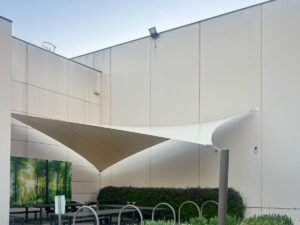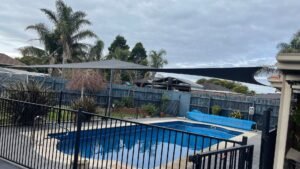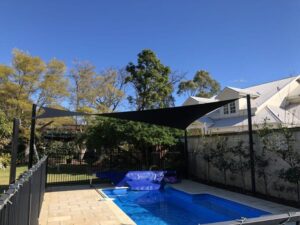

Quick answer: A shade sail installed correctly feels firm and looks smooth, drains water instead of holding it, moves only a little in the wind, and hangs from posts and fixings that don’t budge. If yours sags, pools water, flaps loudly, or hangs from a fascia board, the installation needs attention.
Most people only think about their shade sail when something looks wrong. The middle droops after a wet week, a corner starts flapping, or a post seems to lean a little more than it did last summer. The good news is that you can spot most problems yourself in about a minute. The bad news is that a poorly installed sail is more than an eyesore. It is a tensioned structure carrying real load, so a small fault escalates rapidly.
Whether your sail shades a Brighton alfresco, a Werribee backyard, a school courtyard or a patio in Geelong, this checklist will help you tell what is fine from what needs fixing.
The 60-Second Check
Stand back and look at the whole sail first. Then walk up to each corner.
- The fabric looks smooth and firm, with no deep wrinkles fanning out from the corners.
- After rain, nothing collects in the middle or sags at one low point.
- In a breeze, the sail moves a little, but it doesn’t slap, drum, or snap.
- Every post stands upright and doesn’t move when you push it, with no cracks around the footing.
- Turnbuckles, shackles and eye bolts are tight, with no rust, bent metal or worn threads.
- Fixing points. No corner is attached to a fascia board, a fence or a tree.
If you can tick all six, your shade sail is installed correctly and in good shape. If you can’t, the table below explains what each symptom usually means.
What Your Shade Sail Is Telling You
| What you see | Likely cause | What to do | DIY or call a pro |
| Shade sail sagging in the middle | Too little tension, a sail that is too flat, or stretched fabric | Re-tension evenly at each corner and check the height difference between corners | DIY for a small tweak, pro if it returns |
| Water pooling | Not enough fall, or a waterproof sail hung flat | Increase the high-to-low height difference and adjust the tension | Pro, because ponding adds heavy load |
| Flapping or drumming | Uneven or low tension, or loose hardware | Tighten evenly and check every shackle and turnbuckle | DIY first, pro if it continues |
| Wrinkles at the corners | Uneven tension, or corners at the wrong height | Adjust one corner at a time and recheck | DIY or pro |
| Leaning post | Weak footing or too much load | Stop using the area under the sail | Pro, straight away |
| Rusted or bent hardware | Age, or unsuitable fittings | Replace with marine-grade hardware | Pro |
| Fascia or fence movement | Fixing to a structure that can’t take the load | Re-anchor to a proper post or structure | Pro, straight away |
-
Check the Tension
Tension is what holds a sail’s shape. If it is too loose, the sail sags, flaps and collects water. If it is too tight, you stress the fabric, stitching and fixings. The goal is firm, even, wrinkle-free, with the load shared across every corner.
Most sails have turnbuckles for fine-tuning, so adjust one corner at a time in small steps, then recheck the whole sail. Fabric also settles in the first few weeks, so an early recheck is completely normal.
-
Check the Fall and Where the Water Goes
A well-installed sail isn’t hung in one flat plane. Installers set two opposite corners high and two low, a shape called a hypar twist, so that water has somewhere to run. This matters most for waterproof shade sails, because water can’t pass through PVC. Mesh is more forgiving, since rain drips through the weave.
There is no single correct slope. The fall you need depends on the sail’s size, fabric and design, and published guidance varies. One Australian supplier, for example, asks for at least 300 mm of fall on heavy-duty mesh and 500 mm on waterproof fabric. Treat figures like these as a starting point, and ask your installer what your site was designed for. If water is still sitting on the sail after rain, the fall is too small.
-
Check the Posts and Footings
A sail catches wind like a wing, and that force travels down the posts into the ground. Check that every post is upright, doesn’t move when you push it, and shows no cracks in the concrete. Some DIY guides suggest footings at least 800 mm deep. Larger and waterproof sails usually need engineered posts and footings sized for the site, which our guide to choosing steel posts for a commercial outdoor shade canopy explains in more detail.
-
Check the Fixing Points and Hardware
All shackles, turnbuckles, bolts, and eye plates must be tight and free of corrosion. Fittings that rust or bend can fail with little warning. Where the sail attaches matters just as much as what it attaches with a fascia board is a common shortcut and a common cause of failure, which we explain in why attaching a shade sail to your roof fascia is a costly mistake. Fixing to brick or concrete needs its own specific engineering.
-
Check How It Handles Wind and Weather
Melbourne can throw four seasons at your sail in a single day, so it should cope with gusts without violent flapping. A sail that drums loudly is telling you its tension or hardware needs a look. Some owners remove lighter sails for storm season. Follow the fabric supplier’s guidance and your installer’s advice, and recheck the tension, hardware, and posts after strong weather. Regular upkeep also helps a sail last, as covered in why some shade sails last 15 years while others fail in two.
Does Your Sail Need Engineering or Council Approval?
It depends on your site, but it is worth checking both. For permanent sails, engineering is recommended and often required. Approval rules depend on the structure’s size, height and position, and they vary by council. Check with your local council and a building surveyor before installing or changing a sail. As registered builders, we can help you work out what your site needs.
When To Call a Professional
Call an installer if a post leans, a fixing moves, water keeps pooling, or you simply aren’t sure the structure can carry the load. A shade sail audit and inspection checks your tension, hardware, posts, and fixings against what your site actually needs. A professional shade sail inspection once a year, and after any big storm, is a sensible habit. For repairs and upkeep, see our Maintenance & Repairs page.
Frequently Asked Questions
How do I know if my shade sail is installed correctly?
Look for six signs: smooth, firm fabric; no pooling water; little noise in wind; upright posts; tight, rust-free hardware; and fixing points that aren’t on a fascia board, fence, or tree. If any of these fail, get the sail checked.
How tight should a shade sail be?
Firm and wrinkle-free, with even tension at each corner, but not so tight that the fabric, stitching, or fixings are strained. It should flex slightly in the wind rather than sit rigid.
Why is my shade sail sagging?
Usually because of low tension, a sail hung too flat, stretched fabric, or loose or shifting fixings. Re-tension evenly first. If the sag returns, the cause is probably the geometry or the structure, and it needs a professional look.
Why is water pooling on my shade sail?
The fall is too small, or the sail is under-tension. Water is heavy, so pooling can stretch the fabric and overload the fixings. Treat it as a fault to fix, not a quirk.
Should I take my shade sail down in winter?
It depends on the sail and how it was engineered. Follow the supplier’s guidance and your installer’s advice, and check the sail after any strong weather.
Can I fix a poorly installed shade sail myself?
Small tension adjustments are often fine. Tasks involving posts, footings, fascia fixings, or structural load require a professional installer.
How often should I have my shade sail checked?
Look it over yourself every few months and after strong weather. Book a professional audit about once a year.
Don’t Wait for the Next Storm To Find Out
A sail that looks slightly off today can become a safety problem after the next big blow. Our team will check your tension, fall, posts, and fixings, and tell you plainly what is sound and what needs fixing.
Contact us today for a free measure and quote, or to book an inspection of your existing sail.
We work on residential and commercial sites across Melbourne and Geelong.