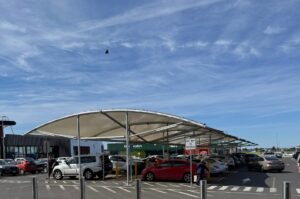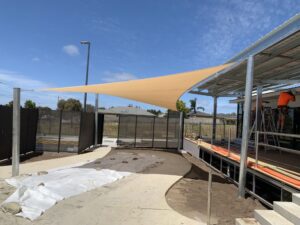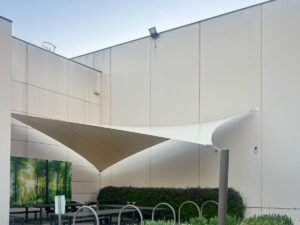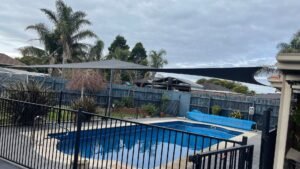
Outdoor courts are some of the busiest spaces on a school campus. They host PE classes, lunchtime games, inter-school sport and whole-school gatherings. However, open asphalt and acrylic surfaces absorb heat, reflect glare and leave students exposed during peak UV hours.
Covering a court is not the same as shading a playground. A court needs a wide clear span, a high ceiling over the playing area and posts kept out of the run-off zone. This guide compares the three main ways Victorian schools cover a basketball or netball court. It also explains the clearance and compliance rules that decide which option is realistic. For the wider picture, see our school shade sails page.
Short Answer
Most schools choose between three options: multi-sail tensile canopies, clear-span barrel vault or cantilevered structures, and solid-roof COLAs (Covered Outdoor Learning Areas). For netball, Netball Australia’s August 2026 court cover fact sheet says the lowest part of the structure, including lights and fixtures, should be no lower than 7.5 m. It also says support posts must sit outside the run-off zone. Fabric sails can work over a court only if every low point sits outside the play and run-off areas, and an engineer must confirm this for your site. Settle the clearance rules first, then choose the structure.
Why Unshaded Courts Limit Pe And Sport
In Victoria, UV levels are generally 3 or above from mid-August to the end of April, according to the Department of Education’s sun protection policy. That period covers most of the school year. Dark asphalt and acrylic surfaces absorb solar heat and run hotter than the surrounding air. Netball Australia also lists reduced surface temperatures and a longer acrylic surface life among the benefits of covering a court.
Without overhead cover, schools tend to face three problems:
- Shortened PE and lunchtime play. Students overheat faster during active drills, so teachers cut sessions short or move indoors in warm weather.
- Shade gaps. The Department’s shade sails policy mandates that school councils provide sufficient shelters and trees for adequate coverage.
- Lost multi-purpose space. An uncovered court cannot double as a shaded assembly area or a wet-weather gathering space.
The Three Main Options Compared
Every campus has different court dimensions, wind exposure and budget. The three options below differ mainly in how they handle clearance, posts, rain and drainage. We have not ranked them on cost, because that depends on the engineering, footings and drainage at your site.
-
Multi-sail Tensile Canopies (knitted Hdpe Mesh)
Overlapping sails are tensioned between steel posts. They are usually made from commercial-grade knitted HDPE shade cloth, and high-grade fabrics can block up to 98% of UV, depending on the product. Ask the manufacturer for test data. The porous weave lets warm air rise through the fabric, improving thermal heat dissipation. However, mesh provides shade and light shower protection rather than full wet-weather cover.
The challenge over a court is sail geometry. Sail corners are normally the low points, so every part of the fabric and hardware above the play and run-off areas must stay at or above the required height. This can mean taller posts and larger footings. Have the design engineered and priced before assuming sails are the cheaper option. Mesh sails typically do not need guttering.
-
Clear-span Barrel Vault And Cantilevered Tensile Structures
A barrel vault uses curved steel arches to carry a tensioned membrane across the full width of a court, with no columns inside the span. A cantilevered design places heavy columns along one side and projects the canopy out over the court. Both provide a consistent clear height across the playing area, with all structural columns positioned outside the court boundary.
The membrane can be mesh for shade, or waterproof architectural PVC for full sun and rain protection. Expect heavier steel and deeper bored concrete footings than a sail needs. A waterproof membrane also requires stormwater drainage.
-
Solid-Roof COLAs
A COLA is a steel portal frame with sheet-metal roofing, gutters and downpipes. It gives complete weather protection, so PE, assemblies and community sport can go ahead in any conditions. However, it can trap heat and amplify ball and whistle noise unless ventilation and acoustic treatment are designed in. It also carries the largest civil works cost because of the roof area, guttering and stormwater connections.
The Department’s shade sails policy covers fabric structures only. Schools planning a solid-roof structure are directed to separate requirements, so do not assume the sail rules apply to a COLA.
When Breathable Mesh Is The Better Choice, And When It Isn’t
Many schools first ask for a fully waterproof roof so that no class is ever rained out. For an active court, breathable mesh is often worth considering. It lets some wind and heat pass through, avoids stormwater plumbing and can keep the structure lighter. However, every option must still be engineered for the wind loads at your site, so mesh is not automatically simpler.
A waterproof membrane or solid roof makes more sense when wet-weather PE, assemblies or community use are the main goal. Our guide to waterproof shade sails vs mesh covers the trade-offs for Melbourne conditions.
Court Rules That Decide The Design
-
Overhead Clearance Height
Standard playground sails sit too low for court sport. High-arcing shots and goal attempts need a clear ceiling.
For netball, Netball Australia’s August 2026 compliance fact sheet sets a minimum ceiling height of 7.5 m across the court and run-off zones, indoors and outdoors. It notes that some elite-level competition uses 8.3 m. Older Netball Australia and Netball Victoria documents still in circulation state 8.3 m as the minimum. If a council or league quotes that figure to you, ask which edition they reference. The court cover fact sheet adds that the 7.5 m applies to the lowest part of the structure, including lights and other fixtures.
Basketball has its own clearance requirements. Check the guidance for your court level before the design is locked in.
-
Run-off Zones, Posts And Padded Post Protectors
Player safety depends on keeping steel columns clear of fast-moving athletes. Netball Australia’s court cover fact sheet specifies an obstacle-free run-off of 3.05 m around the court and at least 3.65 m between adjacent courts. Support posts must sit outside the run-off zone.
Where columns sit near circulation paths or spectator areas, high-density padded post protectors add impact protection. The same fact sheet recommends planning circulation space when more than one court is covered.
-
Existing Floodlight Poles And Walls
It is tempting to tension a sail off existing floodlight poles, fences or a classroom wall to save money. However, those structures are designed for their own loads, not for the sideways tension and wind load that a large sail applies. An engineer would need to assess each one. In practice, most court projects use new, dedicated posts on engineered footings. We explain the risks in our guide to attaching a shade sail to a brick wall or concrete slab.
-
Standards And Victorian School Requirements
- Wind loads: Shade structures should be engineered for the wind actions at their site under AS/NZS 1170.2. This covers the posts, connections, fixings and footings.
- Fabric: AS 4174: 2018 covers knitted and woven shade fabrics. For PVC architectural membranes, ask the manufacturer for their actual test documentation instead of assuming a standard applies.
- Department of Education rules: The Department’s shade sails policy requires shade sails to be built in line with the Building Quality Standards Handbook, including section 5.1.5 on shade areas. Schools need certified structural computations from a structural engineer, and sails must be recorded in the VSBA asset register. Schools do not need a planning permit for shade sails. This is not the same as a building permit, so confirm the building permit position requirements with your building surveyor.
- Multi-use courts: The Department expects school courts to allow at least basketball and netball on each court, so design for both.
Maintenance and Structural Audits
Under Department policy, schools must visually check shade sail support structures, sails and hardware at least once every 3 months. The principal or a delegate can do this. A registered structural engineer must inspect the structure at least every 3 years and investigate any visible signs of distress or wear. The Department also suggests using the same engineer to check basketball and netball towers during the visit.
A sail that loses tension can flap in the wind, which wears stitching and hardware. Timely maintenance and repairs keep the fabric taut. An independent shade sail audit and inspection checks footings, welds and fabric across the campus.
FAQs
How high should a shade structure be over a school netball or basketball court?
For netball, the minimum clear height is 7.5 m over the court and run-off zones under Netball Australia’s August 2026 compliance fact sheet. The lowest point of the structure, including lights, must meet it. Some elite-level competitions use 8.3 m. Check basketball requirements separately. A structure designed to this height also keeps balls well away from the fabric.
How close can posts be to the court sidelines?
Posts must sit outside the run-off zone, which Netball Australia specifies as an obstacle-free 3.05 m around the court. Allow at least 3.65 m between adjacent courts.
Is mesh or a waterproof membrane better for a sports court?
Mesh suits schools that mainly want UV and heat relief and want to avoid stormwater work. A waterproof membrane or roof suits schools that want dry wet-weather PE and assemblies. Both must be engineered for site wind loads.
Can we attach a court shade sail to existing light poles or walls?
Generally not without an engineer’s assessment. Existing poles and walls are designed for different loads. Most court projects use new, dedicated posts on engineered footings.
Do school court shade structures need a permit in Victoria?
The Department of Education says schools don’t need a planning permit for shade sails. Building permit requirements depend on the structure and site, so confirm them with your building surveyor. Solid-roof structures follow separate Department requirements.
How often must a school shade structure be inspected?
Schools must carry out a visual check at least every 3 months. Under Department of Education policy, a registered structural engineer must also inspect shade sails at least every 3 years.
Plan your school court shade project with ShadeScape
Choosing court shade comes down to overhead clearance, boundary safety zones, heat and glare reduction, and long-term maintenance. ShadeScape Sails & Structures is a registered commercial builder with more than 10 years’ experience across Melbourne, Geelong and regional Victoria. We manage design, engineering coordination, permits and installation. To arrange an on-site consultation and quote, contact our team.